
 By Dionesio Grava
First posted in: pinoywatchdog.com
(First of a series)
A July 16, 1996 issue of the Los Angeles Times featured a story about how vandals and nature had taken a toll on public sculpture in Los Angeles. Among others it mentioned that a 41-year-old bronze sculpture located in a public park in the Westlake neighborhood “has been badly defaced by spray-paint vandals and bird droppings. Cleanup and repairs to its concrete base could cost as much as $8000,” it said citing the assessment of art conservators Rosa Lowinger and Glenn Wharton.
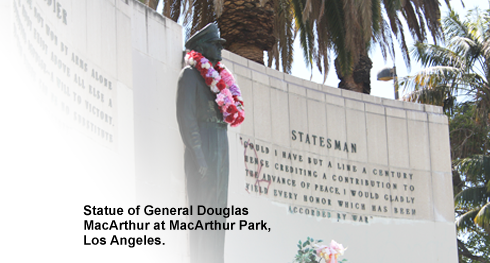
That statue was still in that state of deterioration when our aging World War II veterans descended upon it about nine months later. Designated as Los Angeles Historic Cultural Monument #100 and in whose honor the former Westlake Park has been renamed, the statue of General Douglas MacArthur became the setting of the so-called Equity Village movement. It was on April 14, 1997, Flag Day, when they did it. Located within the ambit of what at that time was the crime, grime and vandalism central west of downtown, it was an unlikely place for tired, aching bodies to occupy for the next 311 days.
Fifteen years may not be too long in the general scheme of things but considering that most of those involved in the historic event were already in their 70s and 80s then, it would be reasonable to expect that many of them may no longer be as spritely to give personal testimonies today, if they’re still around. There were those who, bless their soul, had since gone to the great beyond. To illustrate the scourge of Predator Time, in November 2008 the American Defenders of Bataan and Corregidor disbanded itself after 62 years because, according to Lester Tenney, 88, commander of the organization, there were few “still alive and none had the energy or inclination to lead the group.”
Meanwhile, the Filipino Veterans Equity Act of 2008 became a law and while there are those who criticize it as too little too late, admittedly the one-time payments were a big help to veterans in their advanced years. To the latter it was better than nothing and in fact many had since returned to the homeland after receiving their dues.
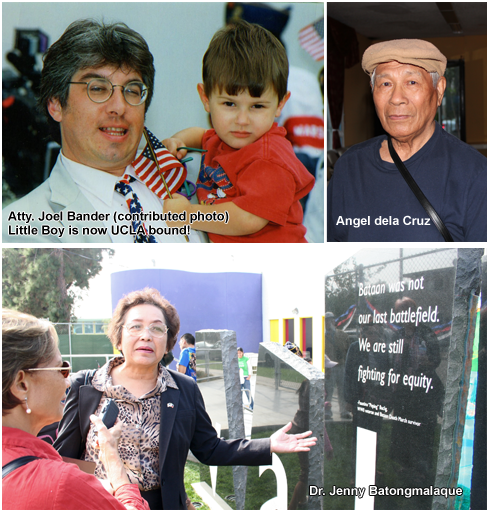
It may be said that the age factor was a significant impelling force that spurred the Equity Village initiative as we will learn later in the story. Among the names that figured prominently in the movement were Nicasio E. Martin, Bonifacio L. Ramo, Pastor Francisco B. Ladia, Alex Romero, Greg Bayani and Bart Gacad. There were of course younger principals such as Rene Junia, Dr. Jenny Batongmalaque and Marlou Balbuena. Hopefully their personal accounts will be available in the next part of this series. Atty. Joel Bander, legal and political adviser of the Coordinating Council of Leaders of Veterans Organizations in Southern California, will be a ready source of clarification considering that he is in the same publication I am connected with.
I also had the opportunity to meet for the first time veteran Angel dela Cruz, a game-changer in the Equity Village cause because of his spontaneous offer to fast which caused abrupt changes to otherwise well-laid plans. Another veteran, Orencio Salem, also did the fasting route later on. Surprisingly Dela Cruz is robust for his age (see photo). Hope they, too, will step up to the plate regarding their respective participation in the movement.
 Genesis
On July 25, 1997 Sen. Daniel K. Inouye (D, Hawaii) testified before the Senate Committee on Veterans Affairs on S. 623, The Filipino Veterans Equity bill. He said at that time that he had introduced the same legislation “in the last four Congresses to right a wrong that has been committed and to provide fair and equitable treatment to Filipino veterans of World War II.”
He proceeded to narrate about the Philippine having been a U.S. possession since 1898 until 1946. The U.S. exercised certain sovereign powers over the Philippines, including the right, upon order of the President of the United States, to call into the service of the United States armed forces all military forces organized by the Commonwealth government.
That precisely was what President Roosevelt did on July 26, 1941 when he issued an Executive Order calling members of the Philippine Commonwealth Army into the service of the United States Armed Forces of the Far East (USAFFE). Under this order, Inouye said, Filipinos were entitled to full veterans’ benefits. More than 100,000 Filipinos volunteered for the Philippine Commonwealth Army and fought alongside the United States armed forces.
Inouye continued: “The United States Armed Forces of the Far East fought to reclaim control, not only of the Philippine Islands, but also of the entire Western Pacific. During this crucial effort to oust our wartime enemy from United States territory, Filipinos fought under the command of General Douglas MacArthur. Filipinos were in the front lines of the battle of Corregidor, fought at Bataan, walked in what became known as the Bataan Death March, and were held and tortured as prisoners of war. These men remained loyal to the United States during the Japanese occupation of the Philippines. They fought valiantly for the allies in the Pacific, waging a guerilla war against the Japanese and helping to delay the Japanese advance across the Pacific.”
After the war was won, however, the U.S. Congress betrayed the Filipino veterans by enacting the Rescission Act of 1946. On February 18 of that year Congress declared the service performed by the Philippine Commonwealth Army veterans as not “active service,” thus denying many benefits to which these veterans were entitled.
Still there were more injustices to come. The senator said that shortly after the Japanese surrender, Congress enacted the Armed Forces Voluntary Recruitment Act of 1945 for the purpose of sending American troops to occupy enemy lands, and to oversee military installations at various overseas locations. A provision included in the Recruitment Act called for the enlistment of Philippine citizens to constitute a new body of Philippine Scouts. The New Scouts were authorized to receive pay and allowances for services performed in the Philippine Islands, Japan, and elsewhere in the Far East. Although hostilities had ceased, wartime service of the New Philippine Scouts continued as a matter of law until the end of 1946. The force gradually disbanded and was disestablished in 1950.
At that time the War Department took the position that the New Philippine Scouts were members of the regular army and therefore entitled to veterans benefits on the same basis as the Old Philippine Scouts, which were considered part of the United States armed forces. However, on May 27, 1946, the U.S. Congress enacted the Second Supplemental Surplus Appropriation Rescission Act, which included a provision to limit benefits. This provision essentially duplicated the language which limited benefits under the First Rescission Act, and made it applicable to veterans of the New Philippine Scouts.
According to Senator Inouye, the Filipino veterans that fought in the service of the U.S. during World War II are precluded from receiving most veterans’ benefits which were available to them before 1946, and which are available to all other veterans of the U.S. armed forces regardless of race, national origin, or citizenship status.
That, in essence, is the cause of Filipino veterans’ grievances that ultimately prompted the forming of the Equity Village movement. How the leadership of the great United States, which considers itself the bulwark of democracy, justice and fairness, continues to run roughshod on the veterans’ legitimate pursuit for benefits and recognition defies explanation. The former fighters have been made to suffer so much, driven to penury for too long such that one is led to ask: Is the money part of the issue too huge thus prompting this rich and powerful country to default on its moral obligation and responsibility to Filipino soldiers it conscripted during WWII? The fact is that viewed within the context of ongoing conflicts and even routine U.S. expenditures, the amount involved in the Filipino veterans’ cause constitute a minuscule amount of what’s being spent in a matter of hours of fighting in Afghanistan, for example.
And so for several decades our war weary, age-bent veterans resurrected the fight, shedding the same sweats and tears to right a wrong. They had been on the quest for an end to the cruel discrimination for 51 years-plus. Still without a glimmer of hope, they finally decided on Flag Day 1997 on a new course of action. Salvation had to be attained before natural attrition further diminished their dwindling numbers.
The Filipino veterans concerned resolved to implement their plan for fairness and justice during a June 14 program 15 years ago. Soon after, the so-called Equity Village sprouted at the site of the statue of their leader, General MacArthur.
The series of protest actions soon involved a hunger strike and a 23-day caravan covering some 7,300 miles to the nation’s capital. They made stops and conducted mini-rallies in the cities of Phoenix, El Paso, Dallas, Kansas, Chicago, New York, New Jersey, Little Rock and Oklahoma. Protest rallies were also held in front of the White House in Washington D.C. and the Veterans Affairs Building in LA.
Meanwhile, the Filipino Veterans Equity Bill sponsored by Congressmen Bob Filner (D-CA) and Benjamin Gilman (R-NY) and their Senate counterparts Daniel Inouye and Daniel Akaka, both Democrats from Hawaii, had been languishing a long time for lack of support among their colleagues. The proposed legislation was intended precisely to correct the injustice committed against our WW2 veterans.