(Translated from Japanese News)
“Conveniently cut-off” Nichii contract termination: Women in their 40s living in poverty, hotel changes, possession of 1000 yen
March 5, 2021 17:55
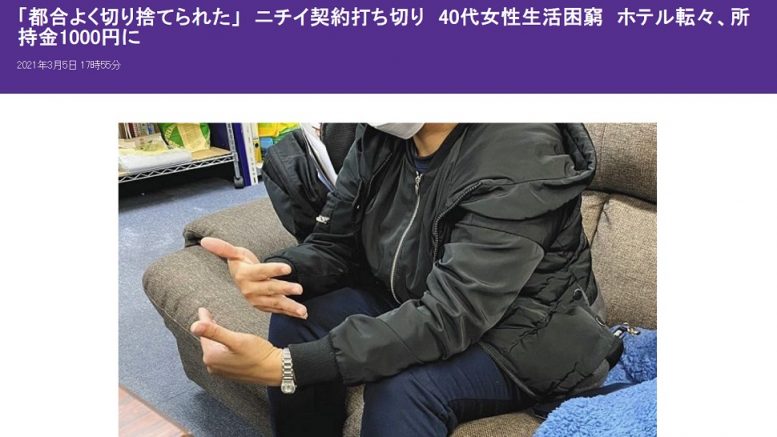
“She worked hard but was really disappointed.” It has become clear that a Filipino woman who came to Japan for a housework support project in the National Strategic Special Zone has not been able to find out where she is because there is no contract renewal from the major medical care staffing agency “Nichii Gakkan”. .. A Filipino woman in her 40s said in tears last year when she was suddenly told by her representative to cancel her contract.
“I wanted to work for 3 or 5 years”
The woman, who has been treated as a self-retirement, told her in November last year that she could not renew her contract because she “she has not reached the passing line on the Japanese exam”.
In her monthly exams, she had never been asked to terminate her contract even if she didn’t pass. She said, “She was hurt. I wanted to work for three or five years if possible.” She is said to have been asked to return home without any mediation from Nichii to another company.
The other 8 colleagues who came at the same time were also suspended for the same reason, and in disappointment, 5 gave up and returned to Japan.
However, for 21 years after her divorce, she has raised three children with one woman. Her two daughters got married and became independent, but her son had to pay tuition at college and took care of her mother.
The woman said, “I trained for three months for national qualifications, and after more than a year of Japanese interviews and cooking training, I longed for a day to work in Japan. She will return to support her child’s school expenses and mother. No, “she complains.
Her money on hand is only 1000 yen
With her contract cancellation, the woman’s 40-hour work week, which was allowed under the special zone system, was reduced to 28 hours, and her length of stay was shortened by the end of May this year.
A friend of mine in Iwaki City, Fukushima Prefecture called me “I have a job”, but she returned to Tokyo because she couldn’t get a work visa, and she searched for a job at four Hello Work offices and an internet cafe, and went to a capsule hotel or a low-priced accommodation. I changed places. When she notices, her cash is 1000 yen. A lawyer I met at a counseling session at Okubo Park (Shinjuku-ku, Tokyo) on January 2nd connected me to a support group.
She now lives in a shelter with the help of a support group and continues to work at the hotel several times a week, including bed making. She wants to find and sign a company that will manage to accept household chores by the visa deadline and renew her visa.
“I love Japan because the town is beautiful and the food is delicious. However, I’m really sorry for this time because there were many single mothers like me. I worked hard, but in the end, I didn’t have enough explanation. It was cut off conveniently, “he cried.
The story of Associate Professor Hifumi Okunuki, Department of Social Management, Sagami Women’s University, who is familiar with labor issues
It is unreasonable not to renew her contract because she could not stimulate demand while calling a woman as a worker in the National Strategic Special Zone. She is also held responsible for a third-party management council, which includes the Cabinet Office, which manages and supervises. In the future, I would like to see more discussions with the council and have women respond in good faith.
Source: https://www.tokyo-np.co.jp/article/89689
Nichii Gakkan – 206 people without renewing contract, 48 Filipino women whereabouts unknown Visited Japan with housework support Country / capital surveyed
March 5, 2021 17:50
206 Filipino women who came to Japan after being admitted to work as housework support workers in the National Strategic Special Zone of the Cabinet Office were hired or retired for their own convenience. The company’s survey revealed that the contract was not renewed from the ward) and the whereabouts of 48 of them could not be determined. On the 4th, a third-party management council, which is composed of the Cabinet Office and the capital and manages the host business, began hearing from the parties concerned. (Isoko Mochizuki)
The national guidelines stipulate that if the person wishes to stay, the employer will endeavor to secure a new place of residence, but the company did not confirm the intentions of the women or introduce them to another workplace.
The third-party management council heard from Filipino women on this day about the circumstances leading up to quitting, the current situation, and their desire to work.
The women answered, “Initially, I was told that I would work for three years, but I was shocked to hear that there was no contract renewal in two years.”
In principle, the Immigration Control and Refugee Law does not allow foreigners to enter the country for the purpose of supporting household chores such as nursing care for the elderly and cleaning the home. However, in 1 city and 5 prefectures designated as special zones such as Tokyo, the status of residence is permitted if certain conditions such as acquisition of national qualifications are met.
According to Nichii, the business started in February 2018 and accepted 632 Filipino women at the end of March 2019 and 695 Filipino women at the end of March 2008. At the end of March 2009, 489 contracts are expected to be renewed, but 206 have retired. Some leave the company for personal reasons, but some are said to have stopped hiring.
When Nichii told the women that he would not renew his contract, he requested that he return to Japan without arranging for another company.
According to the company, 98 people have returned to Japan. Of the 108 remaining in Japan, the whereabouts of 48 are unknown. The woman who did not renew her contract said, “I had no complaints from customers or the company because I worked as a housekeeper, but she was notified of her contract cancellation because she failed the Japanese language exam, and she was also appointed to another company. There was none at all. “
We interviewed five major companies that accept the same business in the same business, but none of them answered that they had stopped hiring or had unknown persons.
Of these, the temporary staffing company “Pasona” has “delayed the arrival schedule of new staff due to the corona disaster,” and the housework support company “Pinai International” has accepted 81 Filipinos since 2017. Has not stopped hiring, and on the contrary, he answered that “there is a shortage of human resources” now.
Shoichi Shijuku, who is familiar with the issue of foreign labor, said, “There was a problem with foreign technical intern trainees, but the problem with domestic support workers was not clear. If the government promotes the expansion of acceptance of foreign workers , We should think of a mechanism that does not cause this kind of thing. “
Nichii’s story
It is true that some people retired without renewing their contract. The low occupancy rate was pointed out by the third-party management council, and the employment plan had to be reviewed. I was told by a related organization in the Philippines that I was dealing with it on the premise that retirees will return to Japan, but in the future I would like to consider as much support as possible in consultation with the council.
Foreigner housework support project One of the national strategic special zone systems set up by the Abe administration for deregulation, the government started accepting people eligible for housework support in March 2017. At least one year of work experience, national qualification for housework support and minimum required Japanese proficiency are required. The host company is required to report working conditions, safety and health, etc. to the third-party management council of each local government and undergo an audit. With a maximum of 5 years, the special zones are currently Tokyo, Kanagawa, Aichi, Osaka, Hyogo, and Chiba. As of January this year, 887 people are working.